Welcome to Act Against Your Nature
“Tim you are so smart, but you’re bad at conflict.”
I am by nature a very argumentative and opinionated person. I am also a high-IQ conceptual thinker and tend to see things others don’t (broader or just quicker.) Early in my career, while I lived in Minneapolis and then moved to Philadelphia I was told, “Tim you’re so smart, but you’re bad at conflict.” Without an understanding of the end state or how to correct it, I just accepted it as a character flaw and hoped my output compensated for my “but.” When I got to M&M/Mars in 1999, I was introduced to the Lominger Leadership Architect (LLA) program which they relied on heavily to build leadership competency in their managers. After a year working there I received my first 360 feedback results. Being naturally skeptical, I jumped straight to “Conflict Management” to see how I scored there to validate if this was trustworthy. To my surprise I wasn’t flagged as unskilled. I was rated OVERUSED by my colleagues.
Overused Strengths
Say what?!? Overused, what is that? The observed behaviors of someone overusing conflict management look like this:
May be seen as overly aggressive and assertive
May get in the middle of everyone else’s problems
May drive for a solution before others are ready
May have a chilling effect on open debate
May spend too much time with obstinate people and unsolvable problems
This is straight out of the LLA content. You can buy the book “For Your Improvement” 3rd Edition by Lombardo and Eichinger or you can contact Korn Ferry who administers the program now. This information fed my development, but my advice is not a Lominger program.
For contrast, somebody skilled in conflict management exhibits these observed behaviors:
Steps up to conflicts, seeing them as opportunities
Reads situations quickly
Good at focused listening
Can hammer out tough agreements and settle disputes equitably
Can find common ground and get cooperation with minimum noise
Reading that was one of those “smack me in the face and call me sugar” moments. My intent and purpose for engaging in conflict dialogue was exactly what was on the skilled list. However, the behaviors everybody saw were those negative bullets on the overused list. What the book said was that this (character flaw) is actually just an overused towering strength. It told me that I was relying on it when other skills (that I may be unskilled in) would be more beneficial. Skills like influencing, negotiating, planning, listening, and political savvy would be more advantageous.
Practical Application
This is what it means to Act Against Your Nature. And it’s exactly why I built this framework. Acting against your nature is not about changing who you are. I am still a very argumentative and opinionated person. I am still a high-IQ conceptual thinker and tend to see things others don’t. That hasn’t changed. I can be an egotistical prick. The way I chose to reduce the size of my “but” was to intellectualize that I had to modify my behaviors and use additional tools to solve problems. I had to think bigger and recognize that winning the argument or battle meant nothing if you lose the war in the process. If I wanted people to engage with me and work on fixing problems, I needed to be perceived as a problem solver, NOT THE PROBLEM. I didn’t become weak, or soft, or ok with losing. I used my desire to win as a tool to influence changing the way I went about winning and understand what winning looked like.
What you should have picked up here is that I used my innate ability to solve the problem of my unintended consequences. A person that is shy or less confident has to take a different approach to get from unskilled to skilled. This is why I say, “You are not changing you; you are recognizing how you need to behave to get the outcomes you desire.”
“You are not changing you; you are recognizing how you need to behave to get the outcomes you desire.”
This is the number one thing I believe needs to be understood before we go any further.
Behavioral Quadrant Structure
Now that we have established that balancing strengths is critical to being effective, let’s look at two personality axes that illustrate communication styles and ways of working in people. The axes of People vs. Idea and Process vs. Action. Most people tend to have varying degrees of bias or preference for these two axes.
Strong People orientation means you are concerned with what people think or what the outcome will be on others. Idea people tend to be more focused on the objective mechanics of the system rather than the emotional state of the collective. When faced with a personnel decision would you rather be fair or kind?
Strong Action orientation people tend to act first and think later. High Process people prefer to wait and think before acting. This one is easy to see where balance is important, but many people are not balanced across this axis. Your friends told you there is a party at 123 Main Street, you get to the door at that address, do you barge right in assuming you got good info, or do you wait outside until you can see other people coming or find signs that there is a party?
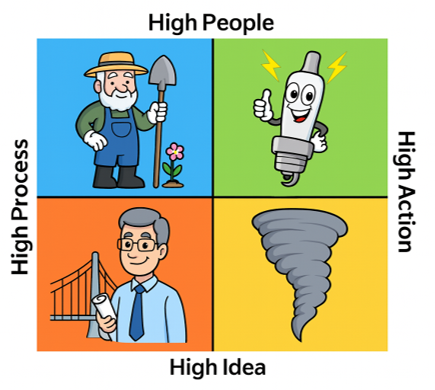
Personality Quadrants
If you look at people with a bias towards the two sides of each axis a quadrant merges at the intersection of these orientations.
High People + High Process = The Gardener (cultivating)
High Idea + High Process = The Engineer (builder)
High People + High Action = The Sparkplug (bold)
High Idea + High Action = The Tornado (brash)
Do you push through, damn the torpedoes?
Do you generate lots of flashy activity?
Do you like to create things that make people happy?
Do you prefer to build things that are functional?
Different personality types are suited for different roles. The great leader knows how to fill the team with diverse skillsets to get the work done. They also understand they must act against their nature and be a balancing force. The system requires balance and if you go full bore in your corner, you create instability and stress.
Business Quadrants
These quadrants now start creating a similar structure when you look at businesses.
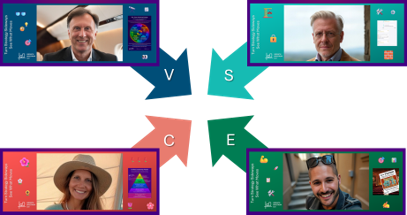
The sparkplug becomes Vision, the place where ambition and value meet the market. Where are you going? Why are you going there? Who wants your product?
The gardener becomes your Culture, where your employees, partners and customers experience the environment you have cultivated. Notice it is cultivated, not stated.
The engineer becomes your Structure, where your rules, controls, processes, data, and systems are built. Proper design and maintenance get you there.
The tornado becomes your Execution, where the activity of things happens. Execution is necessary to get things done. Getting things done right, sustainably, and with purpose requires the other three.
Balance, Again
Just as with personalities, balance is key. If you’ve got an amazing Vision, a superb Culture, world class Structure, but you have no Execution, what’s the point?
If you’ve built great execution, but have no vision, who’s going to buy your product?
If people love your culture, but nothing works, will your people stay happy?
This is the foundation of Growth Spectrum’s work, and the impetus behind the Act Against Your Nature premium blog.
The effective leader reads the situation, figures out what the system needs, and intentionally acts to create balance, growth, and scalability. Sometimes it means modifying your own behavior, sometimes it means bringing in and empowering others who see things different from you, and sometimes it means aligning incentives with desired outcomes. Either way it’s acting against your nature.
What to Expect
This space costs $2 a month. I didn't set that price to make a profit; I set it to establish a psychological boundary. It keeps the casual internet looky-loos out and ensures this comment section is populated exclusively by serious practitioners who are actively running systems in the real world. I promise emotionally raw, contrarian, thought leadership based on real experiences mapped to today’s reality. It’s not just storytelling. It’s intentionally framing an experience from my past to illustrate sociological, psychological, political savvy, business savvy, functional competence, and historical relevance perspectives.
Please check out some of the free preview blogs to see a sampling of what to expect, or sign up today by trying to read an article behind the paywall.
Happy Reading!