The Architecture of Understanding: Lessons from the Silent Gap
The Weight of Assumptions
For the last 18 years, I have lived in a world where the standard rules of communication don’t apply. My son, Ronan, is severely autistic and non-verbal. In our house, we don’t have the luxury of "checking in" or "asking for feedback."
Because Ronan cannot easily tell me what he is thinking, I have learned that the greatest barrier to his growth (and my ability to support him) is my own assumptions. Society tends to fill silence with its own narrative. When people look at Ronan, they often default to a set of convenient, but almost always incorrect, conclusions:
Assuming he is incapable of a task because he isn't starting it.
Assuming he understands a set of instructions just because he heard them.
Assuming his behavior is a lack of discipline rather than a reaction to sensory overload.
Assuming that because he isn't "paying attention" in a traditional way, he isn't absorbing everything around him.

I’ve learned the hard way that when you assume you know what’s happening in a silent room, you are almost always wrong.
How to Discern Truth Without Feedback
So how do you know if your decisions are right when you don't get verbal validation? It requires a relentless, curiosity-driven pursuit of the "Why" behind the "What." You have to stop being a parent who "directs" and start being an observer who "decodes."
Patience is a Requirement, Not a Virtue: You have to be willing to wait days, months, or even years to validate a decision. There are no quick wins in the silent gap.
The "Broccoli" Test (Challenging the Narrative): Everyone told us, "children with autism can't handle lines." But I noticed Ronan loved them. I eventually realized he had decoded a pattern: people don't wait in line for broccoli. If there is a line, there is something high-value at the end of it. He wasn't "handling" the line; he was anticipating the reward.
The Roller Coaster Paradox (Signal vs. Noise): On a roller coaster, Ronan often acts like he is in mortal terror, screaming in a way that makes me look like the worst father in the world. But the moment the ride stops, he drags me right back to the entrance. If I only looked at the "data" of his screaming, I'd never let him ride again. I had to learn to look past the surface noise to see the underlying intent.
Alternate Post-Mortems: Since he can't tell us if he had a good time, we look for different KPIs. We make memory books and blankets. When he looks at a photo from three years ago and speaks an unprompted word while smiling, that is my data point. It’s a reminder that impact is often invisible in the moment it's happening.
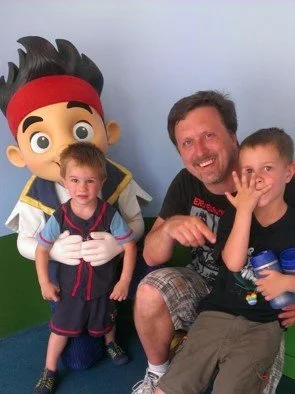
In this picture you wouldn’t know Ronan (right) is actually more upset (scared) than his younger brother (who just wanted an ice cream.)
Why This Matters to My Work
People often ask me how I can balance a 30-year career as a strategic architect with the intense demands of being Ronan’s father. The truth is, I don’t balance them, they are the same work.
The "relentless curiosity" I use to decode Ronan’s world is the exact same tool I use to decode the complex, often silent frictions inside a business.
In my work at Growth Spectrum, I see leadership teams who are "non-verbal" in their own way. They agree on a strategy, but they aren't aligned on the meaning. They look at data and see "screaming" (declining engagement) and assume the "ride" is bad, when the reality is far more complex.
I’ve realized that most business problems aren’t solved by talking louder or doing more. They are solved by Discernment, the ability to look at a situation, strip away the assumptions, and see the actual system at play.
Whether I am at my kitchen table or in a boardroom, my goal is the same: to close the Silence Gap and build a system where understanding isn't left to chance.
The Fallacy of the "Playbook" (Method vs. Outcome)
When Ronan had his first evaluation, the "experts" arrived with a recipe book. They wanted to start with "drill and kill" academic outputs: counting money, addition, and letter recognition. They were measuring him against a standard script of what a child should be doing.
But in my gut, I knew those measurable academic wins were meaningless if the foundation was missing. My goal wasn't for him to count coins; it was for him to “recognize and interact with people and be ‘of this world’”. I wanted him to be aware that there were people to interact with before we ever worried about whether he could add 2+2.
The breakthrough didn't come from a math worksheet. It happened when he tried to bolt out a door, and for the first time in his life, he heard me shout "Stop," turned around, and came back. In that moment, he wasn't just following a command; he was finally present in the world with me.
Business Application: In business, we are addicted to "best practices." We hire consultants who bring the same industry playbook to every company, focusing on "drill and kill" metrics like lead volume or content frequency because they are easy to measure.
But a playbook is just a set of "average practices". Real leadership requires the discernment to know when the standard recipe is actually a distraction from the foundation. Most companies don't need "more" activity; they need to ensure their team is actually "of this world" (aligned on the same intent and aware of the same reality) before they start trying to count the change.

The Horizon of Persistence (The Incremental Wins)
In business, we talk about "10x growth" and "moving fast." In Ronan’s world, we measure speed in repetitions.
For eight weeks, multiple specialists came to our house for hours every day just to get Ronan to use a "manding card" to request a snack. For two months, it felt like we were doing "fruitless" work with zero ROI. But once he finally mastered that single card (once he understood the concept that he could impact the world through a signal) the floodgates opened.
He flew through sentence building with his card. He could request activities, like the water slide at the resort. And then, on my birthday, I heard a tiny voice from the other room saying, “Chip… chip… chip”. He wasn't just holding a card; he was speaking his first unprompted word. Eight weeks of training to get the concept, two weeks to create a card sentence, and then another four weeks to decide on his own he wanted to use his voice. (The video on the right is his specialist trying to capitalize on that moment later.) It took another ten years to get to, “Hi dad, love you” or answer, “How are you?”
Business Application: We often kill great strategies because they don't produce a "miracle" in the first 90 days. We ignore the "manding card" phase of business, the boring, repetitive work of aligning on intent, definitions, and decision systems.
But as an architect, I know that scaling is actually a function of persistence. If you do the foundational work to align on the "Why," the execution eventually looks like a miracle to outsiders. Real growth isn't about the Chip it's about the 8 weeks of work that gave the Chip a reason to exist and built a foundation for further interaction and growth.


Whether I am at my kitchen table or in the boardroom, my role is the same: I am an architect of understanding.
The "miracles" of growth (whether they are a son finally speaking his first word or a business tripling its revenue by uncovering a hidden demand shelf) are never accidents. They are the result of choosing to look past the surface noise to find the actual system at play.
If things in your organization feel harder than they should, it’s likely because you are operating in a gap you cannot yet see.
Where do you want to go next?
Diagnose the Friction: If you felt a "nod of agreement" during the PhillyVoice article, dive deeper into the Silence Gap. Learn how to identify the invisible misalignments and "Systemic Drift" that are stalling your team.
Build the Foundation: If you are ready to move past the "manding card" phase and build a scalable Decision System Architecture, see how we help organizations realign their vision, structure, and execution for predictable growth.