

When Agile Breaks, It’s Not the Framework
A Princeton Agility learning session on why execution systems fail, and how to fix the underlying decision architecture.
You can follow every ceremony. You can run every sprint. You can still stall.
Because the failure is in the system, it isn’t in the process.


The Real Problem
Most teams assume agility breaks at execution. It doesn’t.
Agile doesn’t fail because the process is wrong. It fails because the system is misaligned. Teams follow the framework, run the ceremonies, use the tools, and still struggle to move. Because decisions don’t flow cleanly, priorities conflict, leadership signals are inconsistent.
The problem is in your system; this isn’t an execution problem.

The Moment It Clicks
We started with a simple exercise.
Two employees. One decision. No right answer. What people choose (and why) reveals something deeper, bias toward people vs outcomes, structure vs flexibility, or short-term vs long-term.
The decision isn’t the point. The bias behind it is. That same bias exists inside every organization. And it shapes how the system behaves.
The System Beneath Agile
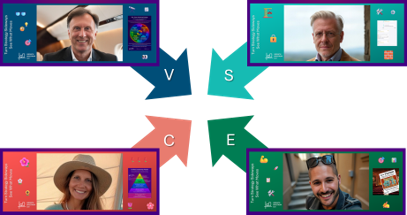
Every organization is balancing four forces: Idea, People, Process, Action
These forces exist in tension: Idea competes with People, and Process struggles against Action. These are not functions. They are competing forces.
When they are balanced you get alignment. When they are unbalanced, drift occurs.
Too much process, no action. Too much people, no facts or ideas, only vibes.


The Drift Mechanism
Leaders favor one side, that bias creates tension
Tension leads to behavior patterns
Patterns cause drift away from balance
Drift creates burden against success (aka failure)
Creating the illusion that the problem is somewhere else. So, teams focus where they are already drifting. If that is structure (process + idea) they fix the backlog, adjust the ceremonies, and change the tools. They never address the actual cause. In this case, they need to enable people and action.
Preview of the Quadrants
From these four tensions, four operatingforces emerge:
-
![VISION Quadrant]()
VISION (people + action)
Movement towards a people goal
“What problem am I solving for people?”
“Why should they buy our offering?”
“How are we uniquely positioned to solve?”
Too much = Chaos -
![CULTURE Quadrant]()
CULTURE (people + process)
Definition of desired behaviors
“How are people empowered?”
“Do people trust each other?”
“Can people relate openly?”
Too much = stagnation -
![STRUCTURE Quadrant]()
STRUCTURE (idea + process)
Definitions and facts - governance
“What are the rules?”
“Do we have reliable data?”
“How will we define success?”
Too much = rigidity -
![EXECUTION Quadrant]()
EXECUTION (idea + action)
Getting things done (right)
“How much did we get done?”
“Did we do it well?”
“Did it do what it was supposed to?”
Too much = burnout


What Leaders Took Away
Resistance is often misalignment, not defiance
Overused strengths create more damage than missing skills
Process cannot fix system-level imbalance
Agility is not something you implement, it’s something that emerges
Agility is an adjective, not a noun.
The Real Shift
The solution is not better standups, sprint planning, or tools. The solution is to fix the system, balance the forces, and align the quadrants.
Agility follows

Fix the System. Agility Follows.
Understand how decision create more resilience than just process.
See the subsystem that turns agility into predictable flow.