Stop Hiring for One Prospect: The Produce Stand Model for Agency Capability Planning
Most agencies don’t fail because they lack talent.
They fail because they build capabilities the way a panicked grocer buys produce: reactively, emotionally, and without any sense of spoilage.
In services, your inventory isn’t software or stock. Your inventory is hours, and hours rot. Every week, unused hours expire. You can’t store them in a warehouse. You can’t freeze them. You can’t “sell them later.”
If you bought 10 cases of tomatoes and threw away nine, you’d call it waste.
In agencies, we call it “bench time.”
Same problem. Just more expensive tomatoes.
🍅 The Produce Stand Model:
A Better Way to Think About Capabilities
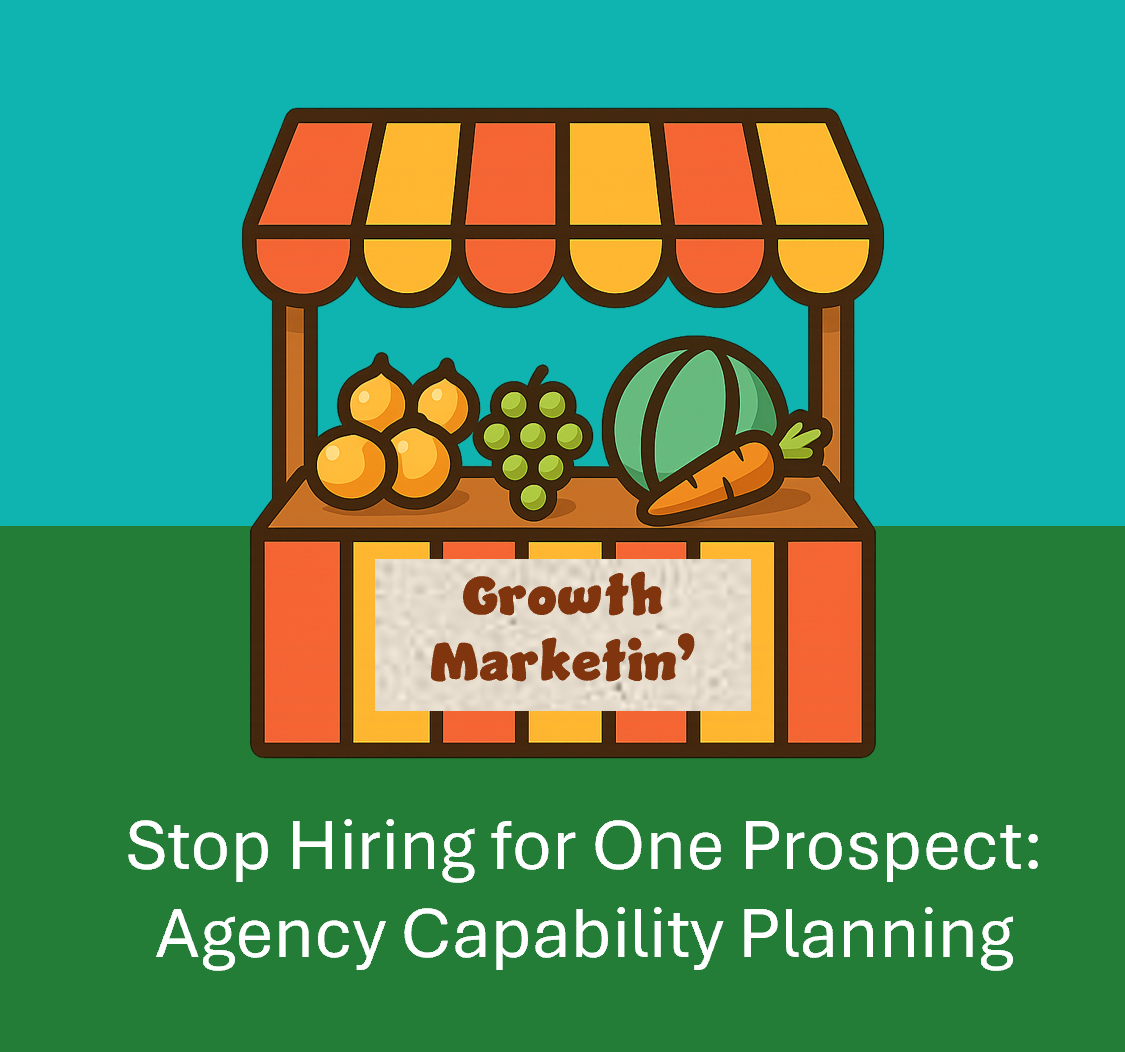
Imagine your agency as a produce stand. You don’t just sell “produce.”
You sell categories:
Fruits 🍇🍉🍐
Vegetables 🥕🫛🫑
Herbs 🌿🫚
Specialty items 🕯️💐
Within each category, you have SKUs:
Tomatoes 🍅
Cucumbers 🥒
Blueberries 🫐
Cantaloupes 🍈
Some items substitute for each other. Some don’t. Some are premium. Some are commodity.
This is exactly how agency capabilities work.
“Growth marketing” isn’t a SKU, it’s a label. It is like saying you sell organic produce.
But organic what? Organic tomatoes? Organic blueberries? Organic beef?
If you tell the market you sell “growth marketing,” you’re saying nothing. If you tell the market you sell lifecycle email, retargeting logic, CRO audits, referral loop design, now you’re speaking in SKUs.
And SKUs are what you can staff, price, and deliver.
What makes a label “premium” vs “capability”?
Premium Label (Positioning Layer)
Signals quality or strategic altitude
Often vague or aspirational
Used in sales decks and LinkedIn bios
Not directly billable
Examples: Strategic Comms, Growth Marketing, Innovation Strategy, Brand Transformation
Capability (SKU Layer)
Specific, scoped, deliverable
Can be staffed, priced, and sold
Shows up in proposals and SOWs
Examples: Crisis Comms, Lifecycle Email, CRO Audit, Brand Voice Guide
The Real Reason Agencies Overbuild Capabilities
Most agencies add new capabilities because:
One prospect asked for it
One founder is excited about it
One team member has a background in it
One trend is blowing up on LinkedIn
This is how you end up with a candle holder aisle when you only have one candle.
Capabilities require:
Demand signals
Feasibility
Talent availability
Pricing power
Category clarity
A real path to scale
Without those, you’re stocking perishables no one buys.
The Flex Bench Doesn’t Solve This, It Exposes It
A flexible bench (full-time, part-time, contractor, freelancer) is powerful, but it doesn’t eliminate the need for discipline.
If you have four CRO experts, but all four are fully booked, you effectively have zero inventory.
If you have one staff hired for a rare skill but no demand, you have rotting inventory.
If you have a category with growing demand but no bench, you have empty shelves.
The bench is not the strategy. The bench is the execution layer of the strategy.
The Three Horizons of Capability Planning
Every agency needs three views:
1. Today (Inventory Reality)
What’s on the shelf?
What’s selling?
What’s spoiling?
What’s out of stock?
2. Near-Term (1–2 Months)
What’s in discovery?
What’s in proposals?
What’s likely to close?
What’s project-based vs. ongoing?
3. Visionary (3–12 Months)
What signals are repeating?
What categories are emerging?
What capabilities could scale?
What’s feasible to build?
This is where most agencies fail, they treat a single prospect as a “visionary signal.”
It’s not. It’s noise
The Capability Feasibility Test
Before you build a new capability, ask:
Have we heard this from at least 3 prospects?
Does it align with our ICP?
Can we define it as a SKU, not a vibe?
Do we have at least 2 people who can deliver it today?
Can we find talent at a viable price?
Can we sell it at a premium?
Does it strengthen or dilute our storefront?
If you can’t answer “yes” to most of these, you’re not building a capability, you’re buying tomatoes you’ll throw away. 🍅🗑️
The Leadership Shift: From Tasks to Systems
This is the real work of a Demand Planner within an agency or services business:
Translate market signals into categories
Translate categories into SKUs
Translate SKUs into staffing plans
Translate staffing plans into feasibility
Translate feasibility into revenue
It’s not about reacting to demand. It’s about designing the storefront. When you think like a produce stand owner, you stop chasing trends and start managing inventory.
You stop hiring for one prospect and start building capabilities that scale. You stop wasting hours and start selling out.
How is your inventory to demand planning?
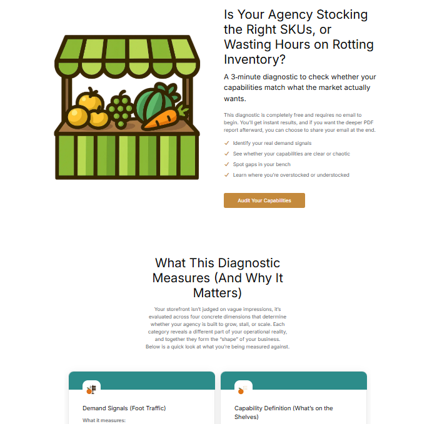
You can’t manage what you can’t see, and most agencies and services providers are making capability decisions without a clear picture of what’s actually on their shelves. If you want to understand how your own storefront is stocked today (what’s selling, what’s spoiling, and what’s silently draining margin) the diagnostic will give you that clarity in just a couple minutes.
Take the Agency Storefront Diagnostic →
A free, quick, no email required, practical way to see whether your capabilities match real demand.