The 3 Archetypes of Leadership Drift
Why smart teams lose clarity, momentum, and alignment, even when everyone is working hard.
Leadership Drift doesn’t happen all at once. It happens slowly, quietly, and predictably, when the four forces of a business (Vision, Structure, Culture, Execution) fall out of sync.
You don’t notice it at first. Things still get done. People still care. The team still shows up. But underneath the surface, the leadership system begins to drift.
Roles blur. Decisions wobble. Communication gets heavier. Execution gets harder. And the organization starts running on effort instead of alignment.
This drift isn’t random. It follows patterns, three archetypes that show up again and again in scaling organizations.
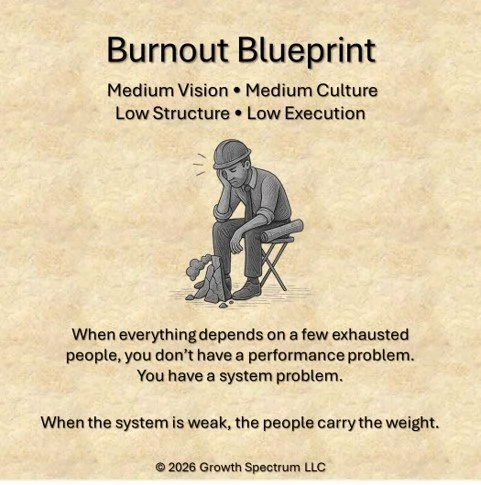
1. The Burnout Blueprint
When the system is weak, the people carry the weight.
This archetype emerges when:
structure is unclear
execution depends on a few heroic individuals
data lives in people’s heads instead of shared systems
processes exist but aren’t followed
the team is always “catching up”t
Leaders in this pattern often say things like:
“Everything falls on the same three people.”
“We’re always behind.”
“I can’t take a day off without something breaking.”
The Burnout Blueprint isn’t about poor performance. It’s about overfunctioning in the absence of clarity.
People don’t burn out because they’re weak. They burn out because the system forces them to carry more than their role was designed to hold.
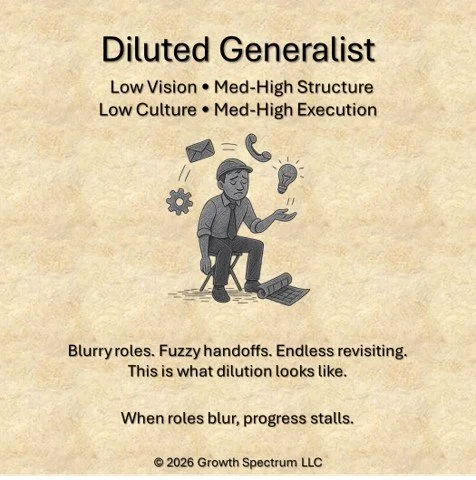
2. The Diluted Generalist
When everyone owns everything, nothing moves with force.
This archetype appears when:
Vision is low
Culture is low
Structure or Execution is “just good enough” to keep things moving
roles are blurry
handoffs are fuzzy
decisions bounce between people
accountability is a moving target
Teams in this pattern feel busy, but not effective.
You hear things like:
“Who’s actually responsible for this?”
“Didn’t we already talk about this?”
“Why does every project feel like déjà vu?”
The Diluted Generalist isn’t about lack of effort. It’s about lack of focus.
When everything is everyone’s job, nothing is truly owned.
3. The Overextended Crew
When speed replaces strategy, everything feels urgent.
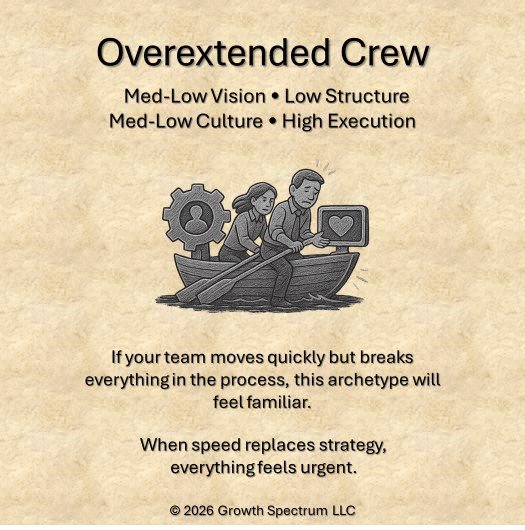
This archetype shows up in high‑energy, high‑execution teams that pride themselves on hustle and responsiveness.
The team moves fast, but without alignment.
You see:
work starting before roles are clear
decisions made before systems are ready
execution outpacing communication
constant urgency
rework, friction, and duplicated effort
Leaders in this pattern often say:
“We’re moving fast, but not forward.”
“Everything feels urgent.”
“We’re sprinting without a map.”
The Overextended Crew isn’t about lack of discipline. It’s about execution outpacing structure.
Speed becomes the operating model, and chaos becomes culture.
The Pattern Behind All Three Archetypes
When you map these symptoms against the UBLD quadrant model, the underlying issue becomes clear:
Leadership Drift = Misalignment across Vision, Structure, Culture, and Execution.
Each archetype represents a different kind of drift:
Burnout Blueprint → Execution Drift
Diluted Generalist → Identity Drift
Overextended Crew → Alignment Drift
Different symptoms. Different expressions. Same root cause.
The leadership system is out of sync.
The Turning Point: When Leaders Finally See the System
The breakthrough moment comes when leaders stop asking:
“Why is this person doing that?”
…and start asking:
“What system made that behavior make sense?”
Because once you see the system behind the symptoms, everything changes. You stop:
firefighting
overfunctioning
compensating
guessing
re‑deciding
And you start:
clarifying lanes
strengthening handoffs
building structural guardrails
aligning roles
designing for scale
This is the shift from effort → alignment.
Leadership Drift Isn’t a Failure. It’s a Signal.
Drift doesn’t mean your team is broken. It means your system is out of sync. When Vision, Structure, Culture, and Execution fall out of alignment, even the strongest teams start running on effort instead of clarity. Once you can name the archetype you’re in, you can finally see the system behind it, and the path back to alignment.
If any of these patterns felt uncomfortably familiar, you’re not alone. You’re seeing the system clearly.
Be sure to read this next
These pieces deepen the pattern and help you understand where drift begins:
The 4 Archetypes of Dysfunction
The foundational patterns that quietly block growth even when things look “fine.”Why Organizations Fix Symptoms Instead of Systems
Why teams feel the pain first, and why leaders often miss the root cause.The Chaos Cycle: Why Agencies Stay Stuck
How urgency, overfunctioning, and leadership habits distort execution.
Ready to see your own drift pattern?
If you want a structured way to understand which quadrant is over‑relied on (and where your leadership system is drifting) start here:
A 20‑question assessment that maps your leadership system across Vision, Structure, Culture, and Execution.
See how others reversed drift
Real examples of organizations that moved from burnout, blur, and overextension to clarity and alignment:
Build a leadership system that stays aligned
If your team is overwhelmed, your roles are unclear, or your execution feels inconsistent, here’s how we help organizations rebuild their operating system:
Not sure where to start?
Tell us what’s going on. We’ll point you in the right direction.