

The Core Leadership Differentiator
You can have all the authority, the title, and the pedigree in the world, but if you lack this one underlying trait, you will never be a great leader. It’s not charisma, intellect, or empathy. It’s malleability, the psychological capacity to absorb feedback, update your mental model, and alter your behavior to build what the system actually needs

The Drift You Don’t Notice Until It’s Too Late
Most organizations don’t break suddenly. They drift. Misalignment doesn’t start with a loud disagreement; it starts with a quiet, unspoken interpretation. A team can nod at a strategy and still walk out of the room with four different versions of reality. This is how Systemic Drift begins, predictably, and almost always unnoticed.

The Company That Couldn’t See Itself
Organizations don't fall apart because of bad intentions; they fall apart because they can’t see themselves clearly. Beneath every 'aligned' meeting is a slow drift in meaning where teams hear the same words but apply entirely different logic. You don’t have a process problem; you have an interpretation problem.

The Founder’s Friction: When the "Visionary" Becomes the Bottleneck
In the early days, a founder’s ego was the engine. But as you scale, that same ego can turn into the emergency brake. It’s not just Founder’s Syndrome, it’s the 'Accountability Vacuum,' where a leader stays in the clouds of 'strategy' to avoid the risk of being measured on the ground. Your job isn't to fix the founder; it’s to build the system that doesn’t need them to change.

The Exit Strategy: Why the Hardest Promotion is Out, Not Up
The corporate ladder is a vertical lie. We pretend moving 'up' is a change in status, when it is actually a change in species. The hardest promotion in business isn’t up, it’s out. Out of the execution that defined your identity, and into the architecture that defines the system’s future.
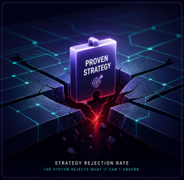
The Strategy Rejection Rate: Why Proven Tactics Fail in Unstable Architectures
Most organizations don’t fail because they choose the wrong strategy. They fail because their internal system rejects the strategy before it can produce a result. Success isn't transferable; it is an artifact of an invisible architecture that competitors, and even the companies themselves, rarely understand.
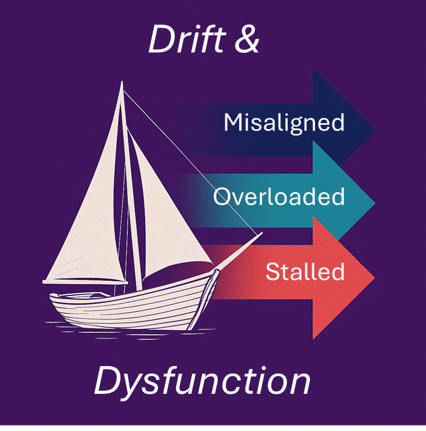
Why Your Organization Keeps Fixing Symptoms Instead of Systems (And How Drift Makes It Inevitable)
Different layers feel drift in different ways. This breakdown shows how misalignment shows up across the org, and why everyone thinks they’re living a different problem.
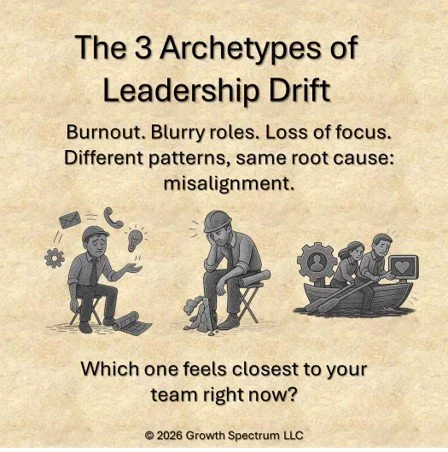
The 3 Archetypes of Leadership Drift
Leadership Drift doesn’t happen overnight, it happens when Vision, Structure, Culture, and Execution fall out of sync. Teams slip into burnout, blurry roles, or constant urgency without realizing the system is drifting. These three archetypes reveal the pattern behind the pain, and how to realign before the drift becomes damage.
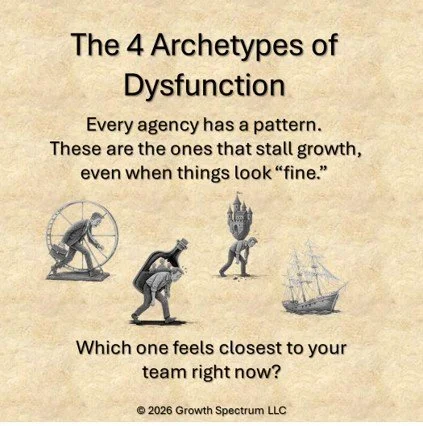
The 4 Archetypes of Dysfunction (and What They Reveal About Your Leadership System)
And across hundreds of teams, four dysfunction archetypes show up again and again. They’re not personality types. They’re not labels. They’re not judgments. They’re systemic patterns that emerge when one or more quadrants of the leadership system fall out of alignment: Vision, Structure, Culture, and Execution.
When these quadrants drift apart, the organization starts behaving in predictable (and painful) ways.

The Agency Problem: When Agent Relationships Aren’t Working
Why Your Team Isn’t Growing, Even When Everyone’s “Doing Their Job”
In modern organizations, misalignment isn’t always loud. Sometimes it looks like quiet compliance, polished metrics, or well-dressed meetings that go nowhere. At the heart of this dysfunction is the agency problem: when agents (leaders, employees, vendors) optimize for their own comfort or success instead of the principal’s goals. Whether you're a CEO, founder, or team lead, understanding this breakdown is critical to restoring momentum, trust, and growth.
This post explores the classic principal-agent dilemma through a modern lens, diagnosing misaligned agency incentives across teams, vendors, and leadership, and offering actionable strategies to realign your organization around impact.