

The Weak Runner’s Head Start
Why You Can’t Hire Your Way Out of the AI Panic
If you are looking to bring AI into your workflow, stop looking outside your walls for a magical savior. 5 years from now, that 6-to-12-month head start won’t even be visible.
Why? Because a weak runner starting early cannot win a race against a fundamentally strong runner.
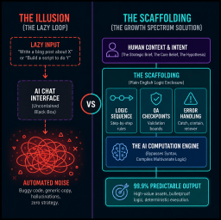
The Illusion of the Single Prompt
Why the Enterprise is Outsourcing Its Brain
Technology rarely creates new human flaws; it simply acts as an amplifier for the ones that already exist. Generative AI is exposing our desperate, lazy urge to outsource the hard work of thinking to an algorithm. If you believe a single prompt can substitute for strategic rigor, you aren't engineering, you are abdicating your role as an architect.

That Sounds Kind of Simple
Why Your Complex Business Has Elegant Answers Hiding in Plain Sight
When people look at solutions that drive 90%+ cost reductions or 8-digit sales growth, their immediate reaction is, “That sounds too simple.” They assume their business is far too complex for elegant answers. But complexity is exactly where operational sludge hides. The highest-leverage solutions are almost always undeniably simple; once you look across the silos to find them.

The $180,000 Hope
Why Your Next Full-Time COO Will Spend Their First 90 Days Failing
When a fast-growing company hits the wall of chaos, the standard playbook says go hire an executive COO. You commit to a $180,000 base salary and pray. But your new hire doesn't arrive with a magic wand; they inherit an empty room. Instead of executing scale, they spend their first 90 days on a corporate archaeology dig, cross-examining you to reverse-engineer the business from your head.

The Company That Couldn’t See Itself
Organizations don't fall apart because of bad intentions; they fall apart because they can’t see themselves clearly. Beneath every 'aligned' meeting is a slow drift in meaning where teams hear the same words but apply entirely different logic. You don’t have a process problem; you have an interpretation problem.

The Strategy Rejection Rate: Why Proven Tactics Fail in Unstable Architectures
Most organizations don’t fail because they choose the wrong strategy. They fail because their internal system rejects the strategy before it can produce a result. Success isn't transferable; it is an artifact of an invisible architecture that competitors, and even the companies themselves, rarely understand.
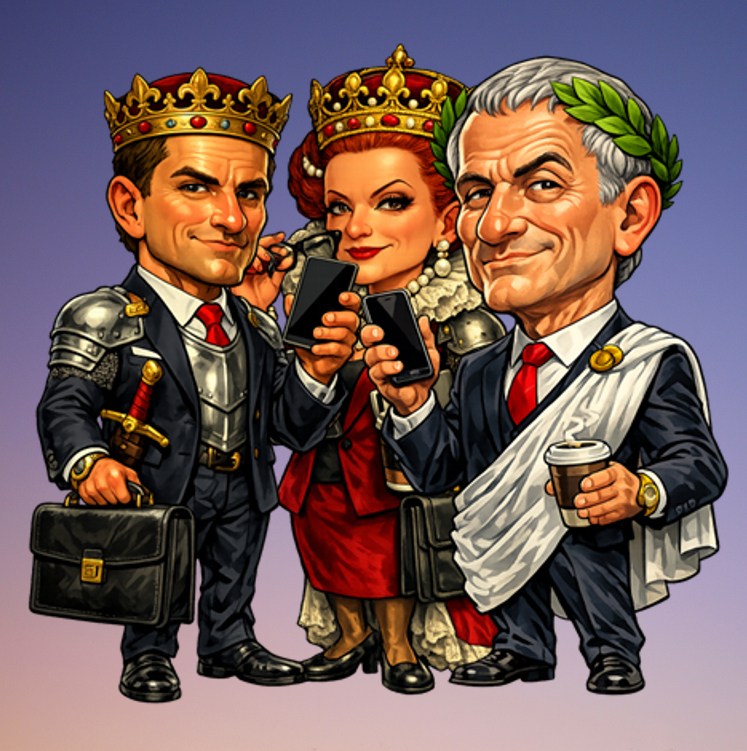
What Henry V, Elizabeth I, and Julius Caesar Can Teach Modern Founders About Leadership Systems
Most leadership frameworks pretend people are simple. The Growth Spectrum Quadrant Model assumes the opposite: Leaders and systems are complex, but the patterns are predictable. From Henry V’s 'France or Bust' execution to Caesar’s board‑room 'assassination,' history reveals exactly how founders drift into the Maturity Vacuum, and how Elizabeth I built a system to outlive it

Most Process Breakdowns Start as Decision Breakdowns
When execution breaks, the instinct is always: ‘We need a better process.’ But you can’t fix a thinking problem with a template. A process tells people what to do, but a Decision System shapes how they think about the work. If your team is constantly debating the 'how,' you don't have a process problem, you have a Decision Architecture failure.

The Talent Isn’t Missing. The Discernment Is.
Companies aren't struggling to find talent. They’re struggling to recognize it. We’ve outsourced the hardest part of hiring (judgment) to algorithms that can't see maturity. Your hiring system isn't broken; it's working exactly as designed. It's just designed to detect the wrong things.
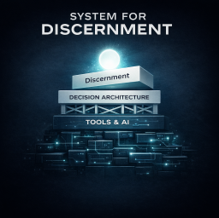
The Age of Outsourced Discernment
AI can recognize a pattern. It can optimize a path. It can accelerate execution. But what it cannot do (and what we’ve quietly stopped doing) is wrestle with whether the path was worth taking. We aren't failing because we lack tools; we're failing because we've tried to outsource the hardest part of leadership: Discernment.

Why Leaders Keep Swinging the Pendulum
Leadership maturity begins the moment you stop chasing relief and start managing the tradeoffs you created. If you choose autonomy, you inherit fragmentation. If you choose standardization, you inherit rigidity. The job of leadership isn't escaping those tradeoffs; it's choosing the ones that fit your strategy.

The Agency Problem: When Agent Relationships Aren’t Working
Why Your Team Isn’t Growing, Even When Everyone’s “Doing Their Job”
In modern organizations, misalignment isn’t always loud. Sometimes it looks like quiet compliance, polished metrics, or well-dressed meetings that go nowhere. At the heart of this dysfunction is the agency problem: when agents (leaders, employees, vendors) optimize for their own comfort or success instead of the principal’s goals. Whether you're a CEO, founder, or team lead, understanding this breakdown is critical to restoring momentum, trust, and growth.
This post explores the classic principal-agent dilemma through a modern lens, diagnosing misaligned agency incentives across teams, vendors, and leadership, and offering actionable strategies to realign your organization around impact.