

The Expert Blindspot
How to Dismantle Broken Systems with Basic Logic
When organizations scale, they naturally default to Expert Deference. We are conditioned to believe that because someone possesses a specific title, a specialized certification, or a high-entry-knowledge degree, their operational systems must be flawless.
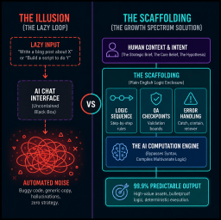
The Illusion of the Single Prompt
Why the Enterprise is Outsourcing Its Brain
Technology rarely creates new human flaws; it simply acts as an amplifier for the ones that already exist. Generative AI is exposing our desperate, lazy urge to outsource the hard work of thinking to an algorithm. If you believe a single prompt can substitute for strategic rigor, you aren't engineering, you are abdicating your role as an architect.
That Sounds Kind of Simple
Why Your Complex Business Has Elegant Answers Hiding in Plain Sight
When people look at solutions that drive 90%+ cost reductions or 8-digit sales growth, their immediate reaction is, “That sounds too simple.” They assume their business is far too complex for elegant answers. But complexity is exactly where operational sludge hides. The highest-leverage solutions are almost always undeniably simple; once you look across the silos to find them.

The $180,000 Hope
Why Your Next Full-Time COO Will Spend Their First 90 Days Failing
When a fast-growing company hits the wall of chaos, the standard playbook says go hire an executive COO. You commit to a $180,000 base salary and pray. But your new hire doesn't arrive with a magic wand; they inherit an empty room. Instead of executing scale, they spend their first 90 days on a corporate archaeology dig, cross-examining you to reverse-engineer the business from your head.

How Companies Rebuild Clarity
Most organizations try to scale by perfecting the map. But a map only works if the terrain never changes. In a high-growth environment, you don’t need a better map; you need a compass. You don’t scale by adding more steps; you scale by aligning the thinking behind the steps.

The Drift You Don’t Notice Until It’s Too Late
Most organizations don’t break suddenly. They drift. Misalignment doesn’t start with a loud disagreement; it starts with a quiet, unspoken interpretation. A team can nod at a strategy and still walk out of the room with four different versions of reality. This is how Systemic Drift begins, predictably, and almost always unnoticed.

Accountability! I Do Not Think That Word Means What You Think It Means.
Accountability isn't a virtue you recruit for; it’s the byproduct of how your system is wired. If the wiring is crossed, no amount of 'Extreme Ownership' will fix the short circuit. You don't need a culture shift; you need an architectural intervention.

The Company That Couldn’t See Itself
Organizations don't fall apart because of bad intentions; they fall apart because they can’t see themselves clearly. Beneath every 'aligned' meeting is a slow drift in meaning where teams hear the same words but apply entirely different logic. You don’t have a process problem; you have an interpretation problem.

The Founder’s Friction: When the "Visionary" Becomes the Bottleneck
In the early days, a founder’s ego was the engine. But as you scale, that same ego can turn into the emergency brake. It’s not just Founder’s Syndrome, it’s the 'Accountability Vacuum,' where a leader stays in the clouds of 'strategy' to avoid the risk of being measured on the ground. Your job isn't to fix the founder; it’s to build the system that doesn’t need them to change.

Accountability Without Authority, What It Cost Me and What I Learned
The room went quiet when the Chairman asked, ‘Why did you give Tim sole responsibility for this when you’d rated him ‘unsatisfactory’ for years?’ That wasn’t a question of curiosity; it was the moment the Official Record and the Operating Truth collided. I had been trusted to run the business, but I hadn’t been given the authority to make the calls. That mismatch turned a project into a mess.

The Exit Strategy: Why the Hardest Promotion is Out, Not Up
The corporate ladder is a vertical lie. We pretend moving 'up' is a change in status, when it is actually a change in species. The hardest promotion in business isn’t up, it’s out. Out of the execution that defined your identity, and into the architecture that defines the system’s future.
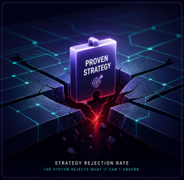
The Strategy Rejection Rate: Why Proven Tactics Fail in Unstable Architectures
Most organizations don’t fail because they choose the wrong strategy. They fail because their internal system rejects the strategy before it can produce a result. Success isn't transferable; it is an artifact of an invisible architecture that competitors, and even the companies themselves, rarely understand.
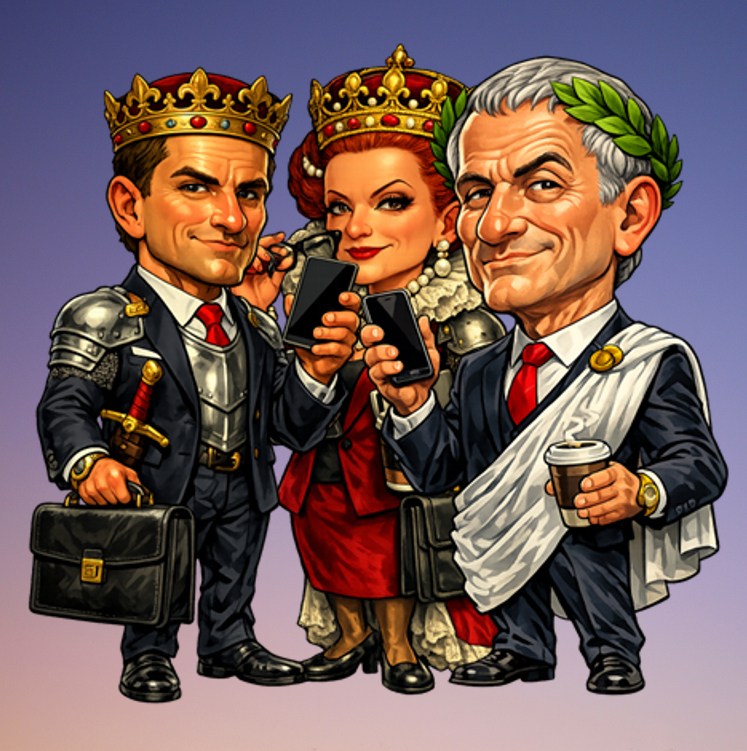
What Henry V, Elizabeth I, and Julius Caesar Can Teach Modern Founders About Leadership Systems
Most leadership frameworks pretend people are simple. The Growth Spectrum Quadrant Model assumes the opposite: Leaders and systems are complex, but the patterns are predictable. From Henry V’s 'France or Bust' execution to Caesar’s board‑room 'assassination,' history reveals exactly how founders drift into the Maturity Vacuum, and how Elizabeth I built a system to outlive it

Accountability Without Authority Is Just Blame With Better Branding
When you demand accountability from a person while stripping them of the authority to impact the outcome, you aren't building a culture of ownership. You are building a Blame System. Execution is where failure becomes visible, but the rot starts in the Decision Architecture

Agile Isn’t Broken. Your System Is.
You can run every ceremony and track every KPI, and still, nothing moves. Most leaders treat Agile like a repair kit, but Agile was designed to enable adaptability, not to fix a missing Decision Architecture. If your team feels busy but isn't being effective, you don't have an execution problem, you have a system problem.

The 12-Hour-a-Year Workload: Why We Are Addicted to the Grind
I told the Chairman I could give him a breakthrough every week. He told me to stop. He told me that if I gave him two (like the one I just gave him) a year, I was successful. He was effectively telling me to work 12 hours a year. Why? Because most leaders are trapped in the Moral Fallacy of the Grind, the belief that for an impact to be big, the effort must be painful.
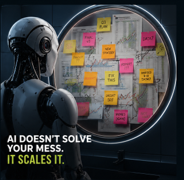
The Mirror of Slop: Why AI’s Biggest Problem is That It Learned from Us
AI isn't a calculator; it's a mirror. If it’s producing “slop,” it’s because it was trained on the decades of slop we’ve produced in our boardrooms and spreadsheets. We expect AI to be smart, but it’s actually doing something much more human: it's prioritizing the loudest signal over the most accurate one.

Most Process Breakdowns Start as Decision Breakdowns
When execution breaks, the instinct is always: ‘We need a better process.’ But you can’t fix a thinking problem with a template. A process tells people what to do, but a Decision System shapes how they think about the work. If your team is constantly debating the 'how,' you don't have a process problem, you have a Decision Architecture failure.

The Invisible Moat: Why Your Competitive Advantage Isn’t What You Think
We were selling $2 worth of candy for $20. And demand didn’t drop. It tripled. Most leaders believe competitive advantage comes from what they can see: pricing, tech, distribution. But real advantage lives in the invisible system underneath. If your advantage can be benchmarked and copied, it isn't an advantage. It’s just a target.

The Myth of Seamless Marketing: Why Every Tool Promises Ease but Delivers Complexity
Every generation of technology repeats the same message: ‘You don’t need expertise. You just need our platform.’ And every generation of leaders eventually discovers the same truth: tools don’t remove complexity. They expose it.